
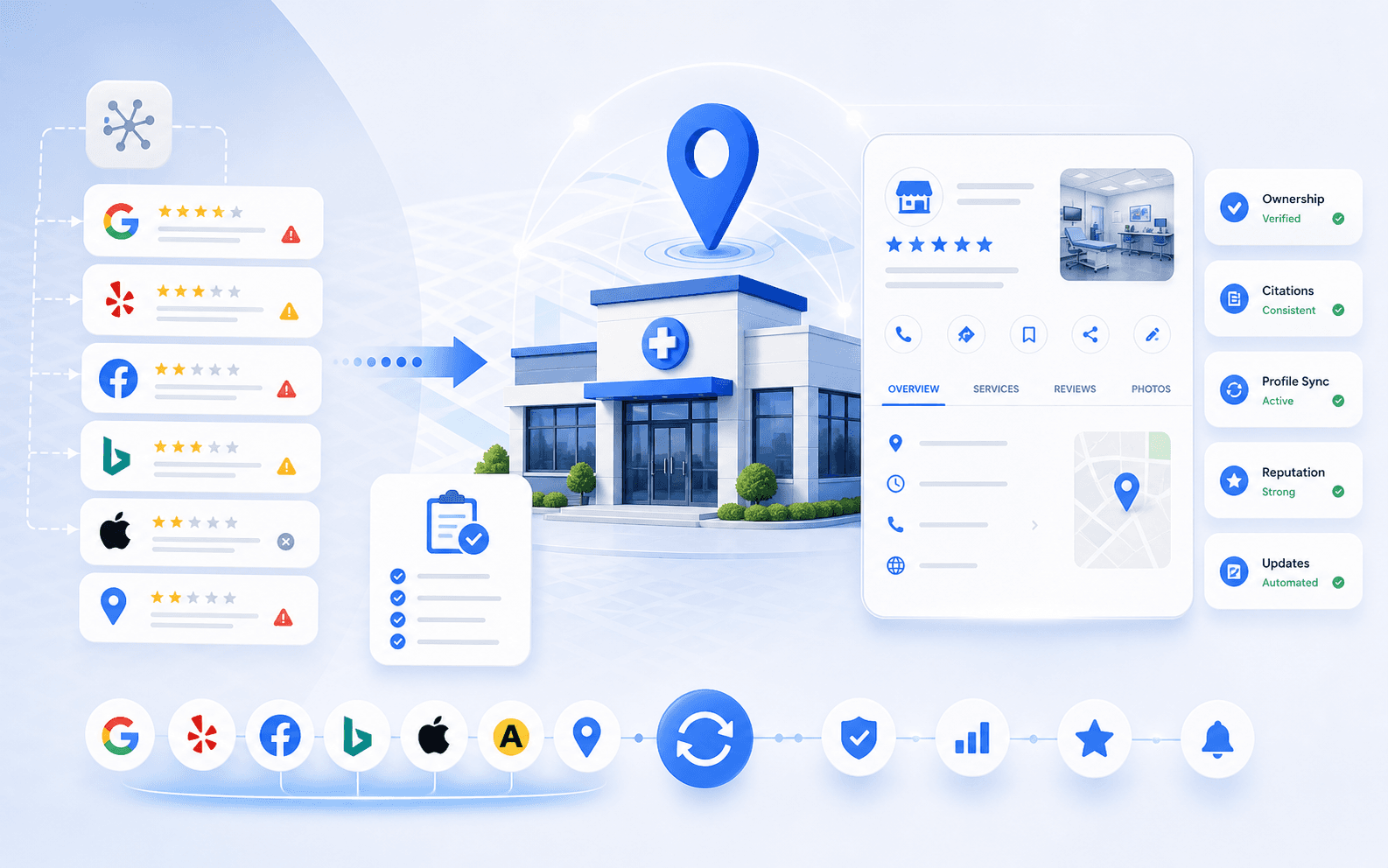
Google Maps is often the first trust checkpoint for local healthcare decisions.
If your clinic is not visible there, patients are more likely to choose the businesses that appear above you.
If you are paying for Yext and thinking about canceling it, the right question is not just whether the subscription is worth the price. The bigger question is what happens to your listings, control, and cleanup workflow after that subscription ends.
That matters because clinics often cancel listings software expecting their data to simply stay fixed forever. In practice, that is not how the local ecosystem works.
Guide overview
What you'll work through in this guide
What changes after cancellation
The most important change is that Yext stops actively managing those listings.
Which listings stay and which need manual control
After cancellation, the listings ecosystem becomes less uniform.
Risks clinics should plan for
Before canceling Yext, plan for the issues that are most likely to create local friction later.
According to Yext's own help documentation, once a listing is no longer managed through Yext, Yext stops sending data to publishers, some publishers may receive a final data snapshot, and publishers can continue using the data they already received, but the way they handle it afterward varies by publisher. In Yext's own explanation, that means data can drift over time when no provider with direct integrations is actively managing the listings. Sources: What Happens After Opting Out Listings in Yext, Cancel Your Yext Subscription.
The short version is this: canceling Yext usually affects distribution control and listing update workflows, so clinics need an ownership, cleanup, and replacement plan before turning it off.
What changes after cancellation
The most important change is that Yext stops actively managing those listings.
That does not mean every listing instantly disappears or reverts. Yext's help documentation says publishers may continue to use data they already received, but they also make their own decisions about what to keep displaying over time.
For clinic operators, the practical meaning is:
- some listings may stay stable for a while
- some listings may lose update control
- analytics and certain Yext-specific publisher indicators can disappear
- data quality may become less consistent over time if nothing replaces the management layer
One recurring misconception we hear is that canceling Yext automatically "undoes" all listings. That is not what Yext says happens. The bigger risk is slower drift, not instant collapse.
Which listings stay and which need manual control
After cancellation, the listings ecosystem becomes less uniform.
Some publishers may continue to show the last clean version of the data for a while. Others may rely more heavily on alternative sources, user edits, or broader data feeds. That means the clinic's listing footprint can become less controlled and less predictable over time.
In real clinic listing environments, this matters most when the business:
- recently moved
- rebranded
- changed phone routing
- has multiple providers or locations
- depends on listing consistency in competitive local markets
The more operational complexity the clinic has, the riskier it is to assume the footprint will remain stable without a replacement workflow.
Risks clinics should plan for
Before canceling Yext, plan for the issues that are most likely to create local friction later.
Common risks include:
- outdated phone numbers lingering in listings
- old addresses continuing to surface
- weaker control over future edits
- lost visibility into where changes still need to happen
- uneven listing quality across publishers
In recurring clinic cleanup work, one of the most common problems is not that the original listings software was wrong. It is that the business turns it off without creating a new owner for the listing layer.
That creates a visibility gap. No one is actively wrong, but no one is actively maintaining the footprint either.
A safer migration workflow
The safest way to leave Yext is to treat the cancellation like a migration, not a billing decision.
That means working through this sequence:
- document the clinic's canonical business data
- identify the highest-value publishers and directory dependencies
- confirm what the clinic actually owns and can update directly
- clean known duplicates or legacy listing issues before the transition
- decide what replacement workflow will manage listings afterward
- monitor for drift after cancellation
That is a much safer process than canceling first and trying to sort out the footprint later.
If the clinic has a broad local presence, this is also the right time to review whether the site, GBP, and citation layer are all aligned. Leaving Yext is usually easier when the underlying local identity is already stable.
When a replacement service makes sense
A replacement service makes sense when the clinic still needs:
- listing governance
- cleanup support
- ongoing consistency checks
- clearer ownership over changes
The point is not to swap one vendor name for another without thought. It is to make sure the clinic is not left with an unmanaged local data layer.
That is why a Citation Builder or a broader listings-control workflow can make sense as the next step. In some environments, the clinic may only need a cleanup and lighter maintenance system. In others, ongoing management is still necessary.
What not to assume when leaving Yext
Avoid these assumptions:
- "If the listings stay live for a few weeks, everything is fine."
- "Canceling will delete all the listings."
- "We can always fix the footprint later without extra work."
- "Google Business Profile is enough, so the rest does not matter."
In local SEO work, it is usually the unmanaged middle period that causes trouble. The clinic is no longer using the old platform, but no one has built the new control system.
Final takeaway
What happens when you cancel Yext? The short answer is not "everything disappears" and not "everything stays perfect."
The better answer is:
If your clinic is evaluating that transition now, start by reviewing the current listing footprint and ownership. Then decide whether the next move should be direct cleanup, a lighter management layer, or a fuller Citation Builder workflow.
Ask these first
- Yext stops actively managing the listings
- publishers may continue showing previously received data
- control can become less predictable over time
- clinics need a replacement plan if they want stable listing quality
Methodology for Yext Replacement: What Happens When You Cancel Yext?
Last reviewed May 5, 2026This article is grounded in reviewed guidance, local SEO workflows, and the source material linked below.
Sources
Frequently Asked Questions About Yext Replacement: What Happens When You Cancel Yext?
Not usually. Yext says it stops sending data, but many publishers may continue displaying the data they already received for a while.
Yes, but it is safer when the clinic has a clear replacement workflow for ownership, cleanup, and ongoing listings control.
The biggest risk is not instant deletion. It is slower data drift when no one is actively managing the listings footprint anymore.

Next step for GBP visibility
Turn this clinic visibility diagnosis into a concrete next move
Use one clear workflow to confirm the issue, improve your Google Business Profile, or get help when the problem involves reinstatement, listings cleanup, or ongoing GBP management.
- Fast visibility scan for clinic locations
- GBP workflows built for local healthcare teams
- Support for rankings, listings, and reinstatement paths
Continue learning
Related Resources for Yext Replacement: What Happens When You Cancel Yext?
Use these supporting resources to go deeper into the topic cluster without losing the thread of what you just learned.
Related Curex resources
Practical resources to keep moving
Foundational guides, tools, and service paths that support the next stage of implementation.
More from this topic
Continue exploring this cluster
Supporting reads that deepen the same topic without competing with the main CTA above.