
Google Maps is often the first trust checkpoint for local healthcare decisions.
If your clinic is not visible there, patients are more likely to choose the businesses that appear above you.
If a clinic wants to review local SEO progress without getting lost in analytics noise, a scorecard is a useful place to start. The right scorecard keeps the team focused on the signals that actually shape local visibility instead of drowning everything in traffic charts and abstract keyword totals.
The problem is that many scorecards are built around whatever is easiest to measure, not whatever matters most. That usually leads to dashboards full of numbers that do not explain whether the clinic is more discoverable, more trusted, or more likely to convert search attention into leads.
Guide overview
What you'll work through in this guide
What to include in a clinic scorecard
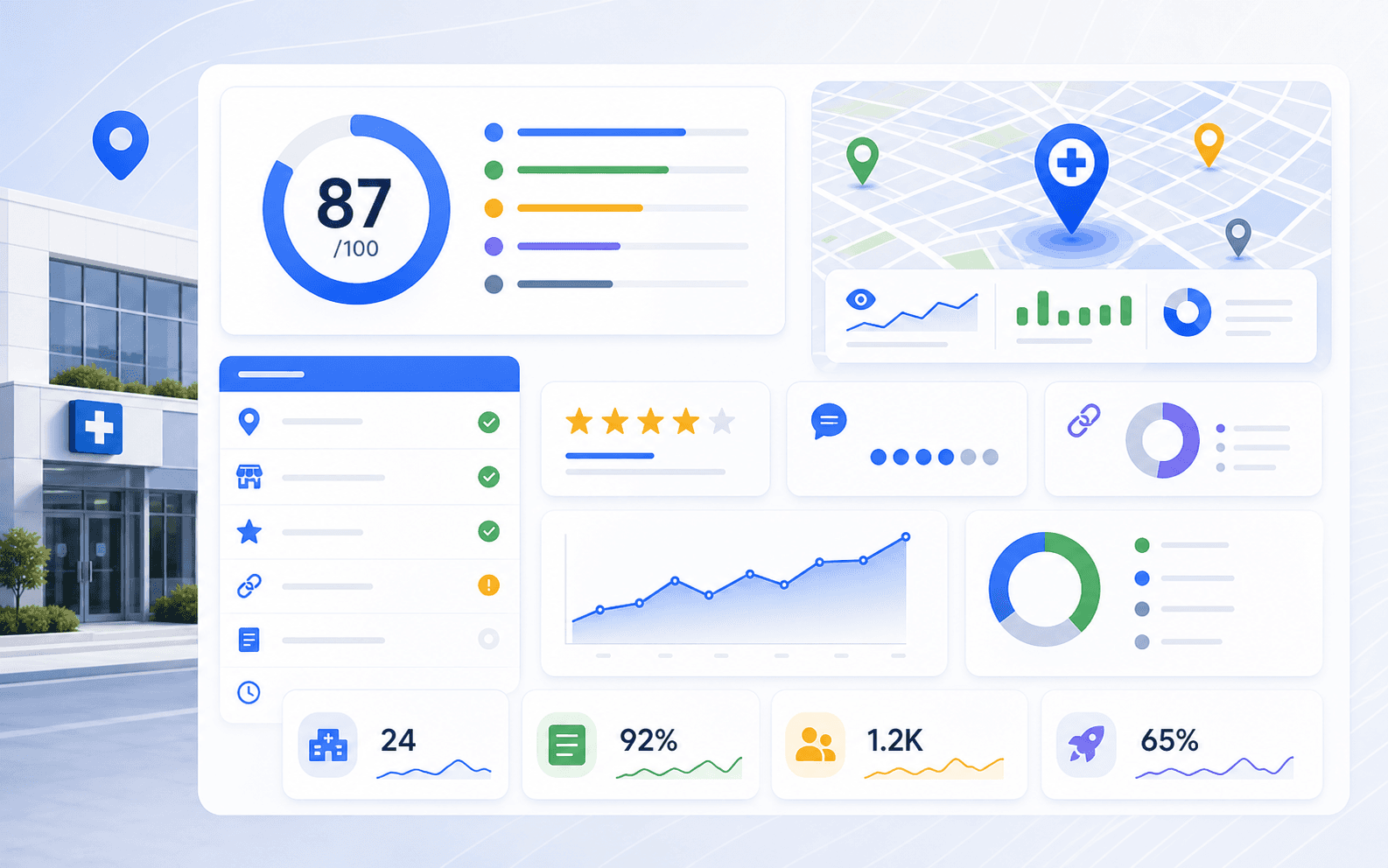
A clinic local SEO scorecard should help answer one simple question: are the local visibility systems getting stronger?
Scoring dimensions that matter
The score itself matters less than the scoring logic. Each section should reflect a meaningful business question.
How to use the template monthly
The value of a scorecard comes from repetition. It should be simple enough to reuse but strong enough to highlight real movement.
The short version is this: a useful clinic SEO scorecard should score GBP, reviews, citations, rankings, service pages, and conversion readiness rather than just traffic or keyword counts.
If you want the fastest way to benchmark those areas before building a larger reporting process, start with the free clinic SEO scan.
What to include in a clinic scorecard
A clinic local SEO scorecard should help answer one simple question: are the local visibility systems getting stronger?
That means scoring the categories that support discovery and patient selection:
- Google Business Profile health
- review strength and recency
- citations and listings consistency
- local ranking coverage
- service and location page quality
- conversion readiness
One recurring issue we see is that clinics use reports that make activity visible but not capability visible. The agency can prove work happened, but the business still cannot tell whether the local foundation is getting stronger.
A scorecard is more useful when it focuses on strength and weakness by system, not just by traffic output.
Scoring dimensions that matter
The score itself matters less than the scoring logic. Each section should reflect a meaningful business question.
For example:
GBP and local presence
Score things like:
- category accuracy
- profile completeness
- website link alignment
- review health
- recent updates or maintenance discipline
Listings and citations
Score:
- NAP consistency
- duplicate risk
- priority directory coverage
- recent business-change cleanup
Reviews and trust
Score:
- review count relative to local competitors
- review recency
- average rating quality
- response consistency
Page quality and local relevance
Score:
- service-page depth
- location relevance where needed
- internal linking
- clarity of commercial pages
Conversion readiness
Score:
- form visibility
- phone click paths
- booking friction
- trust signals near conversion actions
In recurring clinic reviews, this kind of scorecard is far more useful than a broad SEO dashboard because it points directly to what needs work next.
How to use the template monthly
The value of a scorecard comes from repetition. It should be simple enough to reuse but strong enough to highlight real movement.
A practical monthly workflow looks like this:
- review each score dimension
- note what improved
- note what slipped
- flag the biggest blockers
- assign next actions for the next cycle
The goal is not to force every metric upward every month. The goal is to keep the local system honest and visible.
One recurring clinic problem is that no one notices local drift until rankings are already weaker. A scorecard helps catch:
- review slowdowns
- profile changes
- listing inconsistency
- service-page neglect
- conversion friction
before those problems become larger visibility issues.
When to upgrade from scoring to a full audit
A scorecard is useful, but it is not the same as a full audit.
If the clinic sees:
then a deeper audit is usually the better move.
That is where Local SEO Audit Checklist for Clinics becomes more useful. The scorecard tells you the health level. The audit tells you why.
Quick Profile Check
Confirm these visibility basics first
- sharp visibility drops
- duplicate or suspension issues
- unexplained ranking weakness
- uneven performance across neighborhoods
- recent location changes
How this fits into a broader clinic SEO workflow
The best use of a scorecard is not isolated reporting. It is decision support.
It should help the clinic decide:
- what needs cleanup
- what needs monitoring
- what needs deeper investment
- whether the current local SEO system is improving
That is why a scorecard fits naturally between the free clinic SEO scan and a deeper medical SEO services workflow. It helps the team see whether they need lighter monitoring or stronger execution support.
Common scorecard mistakes
Avoid these traps:
- scoring only traffic and rankings
- treating all score dimensions as equal
- building a scorecard too complex to maintain
- hiding weak categories inside one blended average
- using a scorecard without action notes
In recurring clinic reporting, the most common mistake is building a beautiful scorecard that nobody uses to make better decisions.
Final takeaway
A clinic local SEO scorecard is useful when it measures the systems that actually support local discovery:
If you want a starting benchmark, use the free clinic SEO scan. If the scorecard shows bigger structural problems, step up into the Local SEO Audit Checklist for Clinics or a broader Medical SEO Services workflow.
Ask these first
- GBP
- reviews
- citations
- rankings
- page relevance
- conversion readiness
Methodology for Clinic Local SEO Scorecard Template
Last reviewed May 5, 2026This article is grounded in reviewed guidance, local SEO workflows, and the source material linked below.
Frequently Asked Questions About Clinic Local SEO Scorecard Template
It should measure GBP health, review strength, citations, rankings, page relevance, and conversion readiness instead of relying only on traffic or rankings.
Monthly is usually enough for ongoing monitoring, with deeper audits when major visibility changes or business updates happen.
No. A scorecard shows the health of the system, while a full audit digs deeper into why specific weaknesses exist.

Next step for local SEO growth
Move from reading to a clinic SEO action plan
Use the next Curex workflow to turn the article into an actionable growth path, whether you need a diagnostic scan, software support, or hands-on SEO help.
- Built for local healthcare visibility
- Clear path from diagnosis to implementation
- Flexible for software-led or service-led execution
Continue learning
Related Resources for Clinic Local SEO Scorecard Template
Use these supporting resources to go deeper into the topic cluster without losing the thread of what you just learned.
Related Curex resources
Practical resources to keep moving
Foundational guides, tools, and service paths that support the next stage of implementation.
More from this topic
Continue exploring this cluster
Supporting reads that deepen the same topic without competing with the main CTA above.