
Google Maps is often the first trust checkpoint for local healthcare decisions.
If your clinic is not visible there, patients are more likely to choose the businesses that appear above you.
If a clinic is tracking only one rank number, it is probably missing the real local visibility picture. That single number might look clean on a report, but it hides what patients actually experience across different neighborhoods, zip codes, and search points.
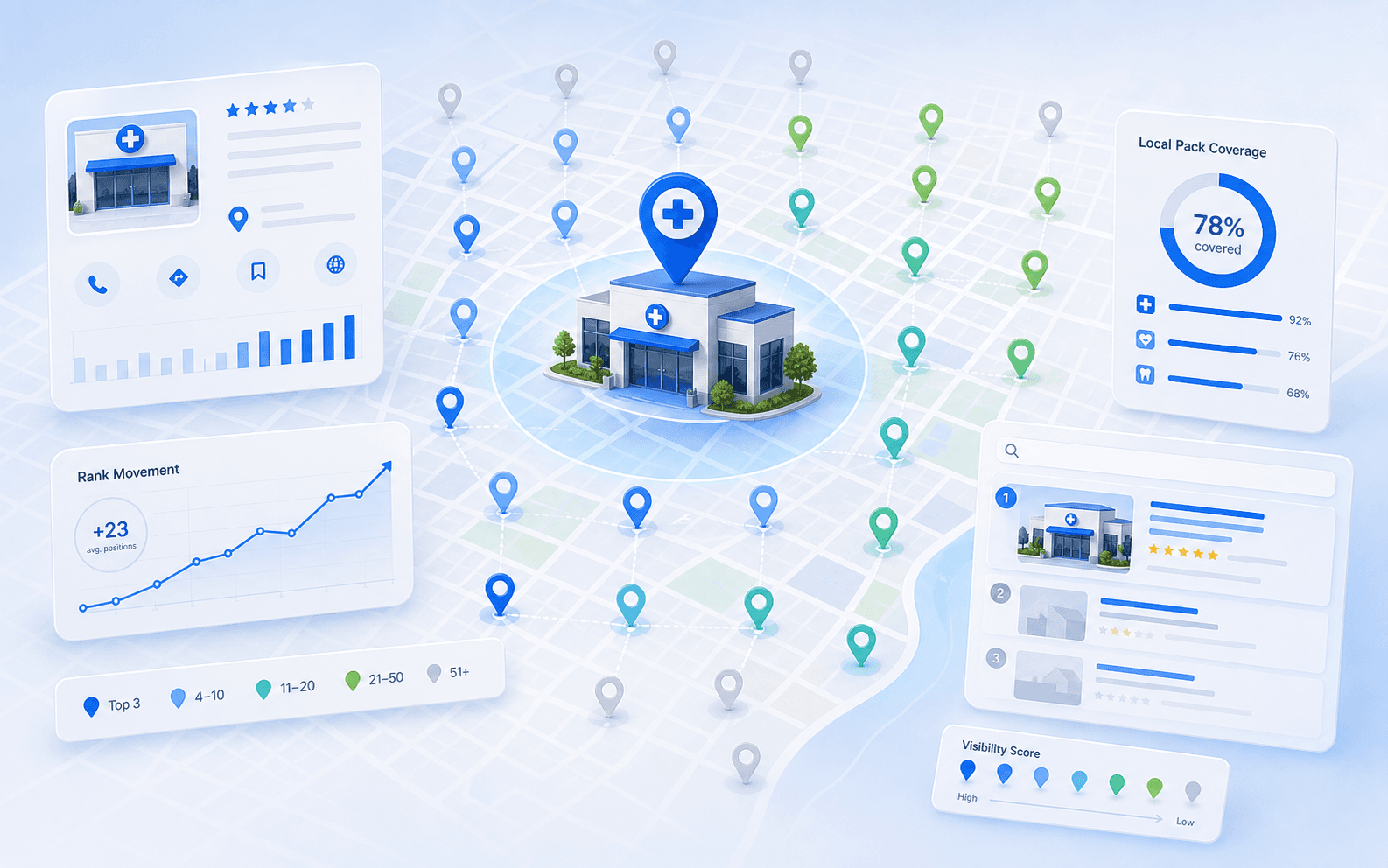
That is why local ranking grids matter. They show how visibility changes across a map instead of pretending the clinic has one universal ranking in a whole city.
Guide overview
What you'll work through in this guide
Why one rank number hides local reality
Local search is shaped by proximity. That means the same clinic can rank well near the office, weakly a few miles away, and barely show up in nei...
How grid tracking works in practice
A ranking grid checks how a clinic appears for a chosen search query from multiple map points across an area.
What clinics should look for in a grid report
The value of a grid is not just the colors or the average score. It is the pattern.
The short version is this: ranking grids show how clinic visibility changes across neighborhoods, making them more useful than a single average rank for understanding actual patient search exposure.
If you want the broader SEO foundation behind those grid results, start with local SEO for clinics. If you want to compare local search more directly across places, the Local Search Preview tool is the lighter workflow.
Why one rank number hides local reality
Local search is shaped by proximity. That means the same clinic can rank well near the office, weakly a few miles away, and barely show up in neighborhoods it still wants to serve.
One recurring issue we see in clinic reporting is that a business gets told "you rank number three" or "you rank on page one," and everyone feels reassured. But when you map that ranking across actual patient search locations, the picture is much less consistent.
That matters because patients do not all search from one point on the map. They search from work, home, nearby commercial zones, and surrounding neighborhoods. If the clinic's visibility fades quickly outside its immediate area, the business is not as discoverable as the report may suggest.
Ranking grids solve that by replacing one vanity number with geographic coverage.
How grid tracking works in practice
A ranking grid checks how a clinic appears for a chosen search query from multiple map points across an area.
Instead of asking:
- "What is our rank in this city?"
the grid asks:
- "What is our visibility from each of these points across the city?"
That gives the team a more realistic view of local search performance.
A typical grid workflow includes:
- selecting a target search term
- choosing a geographic area
- setting grid points across that area
- measuring local pack visibility at each point
- comparing performance across the map
This is especially useful for clinics because service demand is rarely evenly distributed. Some neighborhoods may already know the brand. Others may be more competitive. Others may be outside the practical reach of the clinic's local relevance signals.
What clinics should look for in a grid report
The value of a grid is not just the colors or the average score. It is the pattern.
Look for:
- strong visibility only near the office
- uneven performance by neighborhood
- competitor dominance in specific parts of the market
- different coverage by service query
- parts of the city where the clinic is effectively invisible
In recurring clinic grid reviews, we often see one of three common patterns:
- the clinic is strong near its address and weak everywhere else
- one service has healthy coverage while another barely registers
- the business is competitive in a smaller local zone but cannot sustain visibility in the broader metro it wants to own
Those patterns are much more actionable than one average rank.
How to use grid findings to prioritize action
Once the grid exposes the pattern, the next question is why it looks that way.
If visibility is strong only near the clinic address, the business may need:
- stronger page relevance
- better review momentum
- cleaner citations
- more competitive local trust signals
If visibility varies by service, the site may need:
- stronger service-page depth
- better internal linking
- clearer alignment between the profile, services, and target pages
If one competitor dominates whole sections of the map, compare:
- review strength
- category relevance
- profile completeness
- service-page quality
- local coverage strategy
That is where a grid becomes operational. It stops being a reporting visual and starts becoming a prioritization tool.
For clinic owners, the next step should be tied to the pattern in the grid:
- Strong near the office, weak farther out: strengthen location and service-page relevance before chasing broad-city rankings.
- One service ranks, another does not: build or improve the weaker service page, then connect it from the GBP services, homepage, and related clinic pages.
- A competitor owns one side of town: compare review recency, categories, citations, and page depth before deciding whether that zone is worth pursuing.
- The grid is weak everywhere: start with GBP setup, listings consistency, reviews, and the core local SEO foundation before spending time on small page edits.
A practical clinic workflow is to choose one service, one target area, and one corrective action for the next 30 days. Then run the grid again and compare the shape of visibility, not just the average rank.
When grids are more useful than simple rank tracking
There is still a place for simpler ranking snapshots, especially for smaller clinics or early-stage visibility checks.
But ranking grids become much more useful when:
- the clinic serves a broad city or metro
- search visibility seems inconsistent
- the business has multiple major service lines
- leadership wants to understand neighborhood-level exposure
- competitors seem stronger in some areas than others
One recurring issue we see is clinics trying to make market-level decisions from office-level ranking data. A grid is often the fastest way to show why that is not enough.
How grid tracking fits into the bigger local SEO system
Grid tracking does not fix rankings on its own. It only shows the pattern more clearly.
The work still has to happen in the local SEO system:
- GBP strength
- citations and listings
- review growth
- service-page relevance
- local conversion readiness
That is why grid findings should always feed back into a broader medical SEO services or local SEO for clinics workflow. The grid tells you where the weakness is. The rest of the SEO program tells you how to improve it.
Common mistakes with ranking grids
Avoid these mistakes:
- looking only at the average score
- ignoring service-by-service variation
- treating the grid as a final answer instead of a diagnostic layer
- assuming every weak area should be pursued equally
- using the grid without connecting it to review, page, or profile improvements
In recurring grid reviews, the most common mistake is seeing the map and stopping there. The map is the signal. It is not the plan.
For clinics that need repeatable neighborhood-level tracking instead of one-off checks, Curex local ranking grids provide the product workflow behind this reporting approach.
Final takeaway
Local ranking grids matter because one citywide ranking number usually hides the real local picture.
For clinics, a better question is:
That is what a grid reveals.
If you want to act on this now, use Curex local ranking grids to track the service areas that matter most, then use the Local Search Preview tool for quick spot checks between grid reviews. For the broader clinic visibility foundation behind the data, review local SEO for clinics and turn the grid findings into the next 30-day fix list.
Ask these first
- where are we visible?
- where are we weak?
- how does that change by service and neighborhood?
Methodology for How Local Ranking Grids Work for Clinics
Last reviewed May 5, 2026This article is grounded in reviewed guidance, local SEO workflows, and the source material linked below.
Frequently Asked Questions About How Local Ranking Grids Work for Clinics
It shows how visibility changes across multiple map points, making neighborhood-level exposure much easier to see and act on.
Yes, especially when the clinic serves a broad area or wants to understand why visibility looks uneven outside the immediate office zone.
That depends on market competitiveness, but monthly or campaign-based reviews are usually enough to spot major coverage gaps and progress.

Next step for clinic reputation
Turn this review guidance into a stronger patient trust workflow
Choose the next action that helps your clinic improve review generation, clean up reputation blind spots, and strengthen the signals patients see before they book.
- Review growth workflows that fit healthcare teams
- Clear next actions for reputation improvement
- Built to support local trust and conversion
Continue learning
Related Resources for How Local Ranking Grids Work for Clinics
Use these supporting resources to go deeper into the topic cluster without losing the thread of what you just learned.
Related Curex resources
Practical resources to keep moving
Foundational guides, tools, and service paths that support the next stage of implementation.
More from this topic
Continue exploring this cluster
Supporting reads that deepen the same topic without competing with the main CTA above.