
Google Maps is often the first trust checkpoint for local healthcare decisions.
If your clinic is not visible there, patients are more likely to choose the businesses that appear above you.
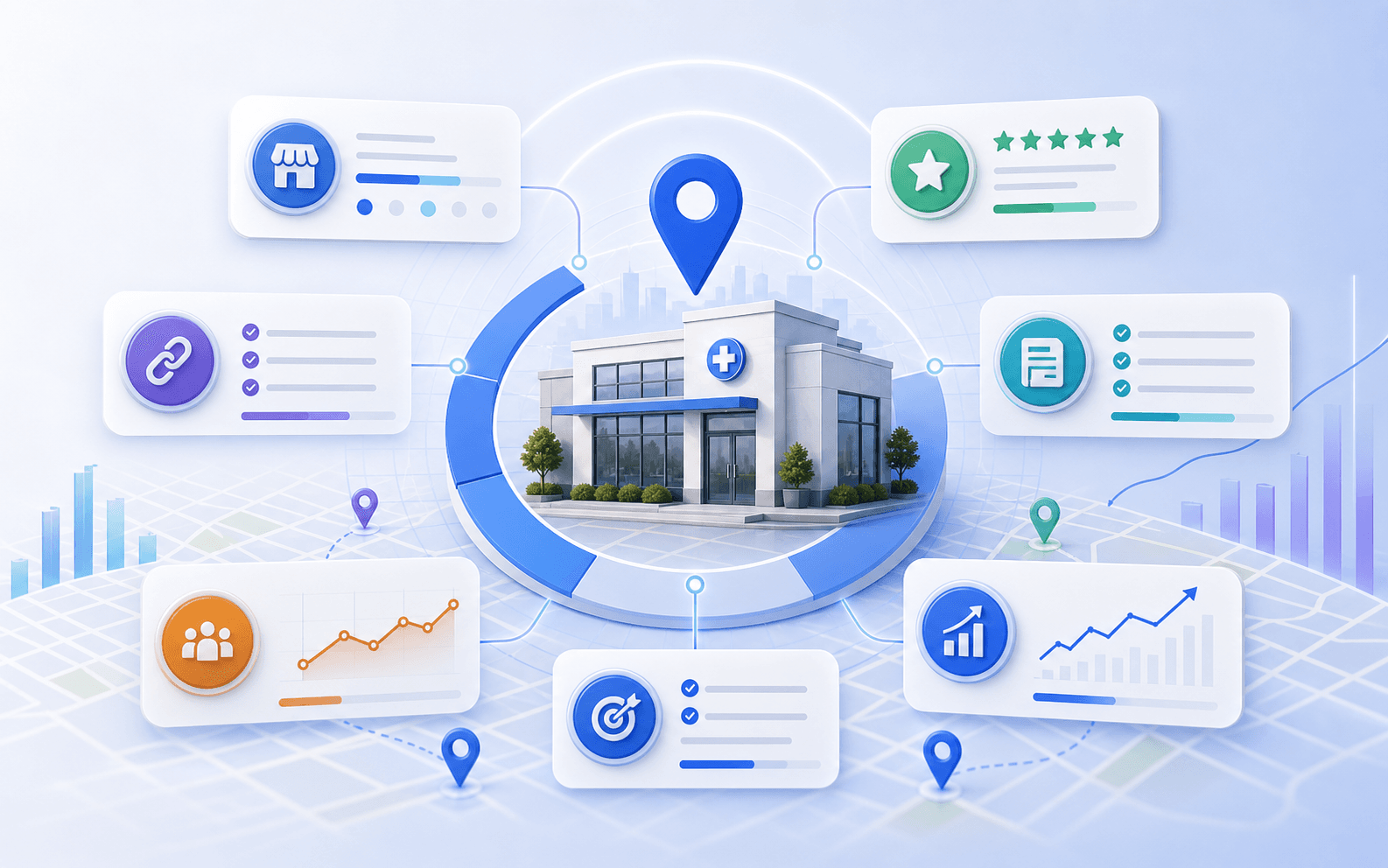
If a clinic wants to understand what actually drives local visibility now, the answer is no longer "just optimize the profile" or "just publish more content." Local search performance is the result of a system, and that system is stronger when the clinic lines up profile clarity, review trust, site relevance, local consistency, and conversion readiness.
That is the logic behind the Curex Visibility Model. It is not meant to pretend one factor controls everything. It is meant to organize the factors that show up again and again in clinic local search performance into a more practical framework.
Guide overview
What you'll work through in this guide
Why generic ranking-factor lists are not enough for clinics
Most ranking-factor discussions stay too broad. They tell you that proximity, relevance, and prominence matter, which is true, but not very opera...
Factor group 1: Profile clarity and operational accuracy
The first factor group is the Business Profile layer.
Factor group 2: Review trust and local selection signals
Review strength matters because it influences both trust and competitive local selection.
The short version is this: clinic local search rankings are shaped most by profile clarity, review strength, page relevance, listings consistency, and conversion-supporting trust signals working together rather than in isolation.
If you want a fast first benchmark of those systems, start with the free clinic SEO scan.
Why generic ranking-factor lists are not enough for clinics
Most ranking-factor discussions stay too broad. They tell you that proximity, relevance, and prominence matter, which is true, but not very operational.
What clinics usually need is a better question:
- what are the visibility systems we can actually control, strengthen, and monitor?
In recurring clinic visibility work, we often see teams spend too much time debating "the algorithm" and not enough time improving the local assets that consistently shape their local performance.
That is why the Curex model is organized around practical local SEO systems instead of abstract ranking-factor language alone.
Factor group 1: Profile clarity and operational accuracy
The first factor group is the Business Profile layer.
This includes:
In recurring clinic reviews, one of the most common weak points is not that the profile is missing. It is that the profile exists but sends a mixed signal about what the clinic really is, where it operates, or how it should be interpreted locally.
That weakens relevance before the business even gets to the website layer.
Quick Profile Check
Confirm these visibility basics first
- correct primary category
- strong secondary category logic
- accurate name, address, phone, and hours
- service-area or storefront setup that matches reality
- service and description alignment
- low duplicate and suspension risk
Factor group 2: Review trust and local selection signals
Review strength matters because it influences both trust and competitive local selection.
This factor group includes:
- review count relative to the local market
- recency
- rating quality
- response discipline
- broader trust impression compared with nearby competitors
The key idea is not "more reviews equals better rankings." It is that a healthy, active review profile often helps the clinic stay more competitive in local comparison environments.
One recurring pattern we see is that clinics assume their review profile is fine because the average rating is good. But when you compare recency and volume against stronger local competitors, the trust gap is still real.
Factor group 3: Website relevance and service-page depth
Profile strength without page strength usually creates a ceiling.
This factor group includes:
- service-page depth
- specialty relevance
- internal linking
- location context where appropriate
- clarity of commercial intent
- supporting educational content around key services
In recurring clinic SEO work, one of the biggest local growth blockers is that the website is simply too broad. The profile suggests the clinic is relevant, but the linked site does not reinforce the same service depth clearly enough.
That is why the Curex model treats site relevance as a core ranking factor group, not a secondary afterthought.
Factor group 4: Listings consistency and identity control
Listings and citations still matter because they reinforce business identity across the local ecosystem.
This factor group includes:
- consistent NAP
- controlled high-value listings
- low duplicate footprint
- stable post-move or post-rebrand identity
- fewer conflicting provider/location signals
One recurring issue we see is that clinics assume Google Business Profile is the whole identity layer. It is not. If the wider listings ecosystem is messy, local trust becomes harder to stabilize.
That is why medical citation building still belongs inside the ranking model.
Factor group 5: Geographic coverage and local exposure pattern
A clinic does not rank the same way across a whole market.
This factor group includes:
- neighborhood-level visibility
- distance decay
- uneven performance across the metro
- service-by-service coverage differences
- competitor dominance in specific local zones
This is where ranking grids and location-preview tools become useful. They show whether the clinic's visibility is narrow, uneven, or competitive across the places that matter most.
One recurring visibility mistake is assuming the clinic has "a ranking" in the city. What it usually has is a visibility pattern across the city.
Factor group 6: Conversion-supporting trust signals
This factor group is often ignored in ranking conversations, but it still matters in the wider performance model.
It includes:
- easy booking or contact paths
- clear page trust signals
- low-friction lead capture
- site experience that supports user action after the click
This does not mean conversion factors replace local ranking factors. It means a clinic local visibility model is incomplete if it separates rankings from what happens after the visit. In real growth systems, the local search layer and the conversion layer strengthen each other.
How clinics should use the Curex Visibility Model
The model is most useful when it becomes a prioritization system.
Use it to ask:
- which factor group is weakest right now?
- which factor group is limiting the others?
- where is the biggest visibility bottleneck?
- what should be fixed first?
For some clinics the answer is profile clarity. For others it is page relevance. For others it is review trust or listings consistency.
The point is not to improve every factor equally at once. The point is to identify the factor group that is most obviously limiting local performance.
What the model does not claim
This is important.
The Curex Visibility Model is not claiming:
- a guaranteed formula
- a universal weighting that applies to every clinic
- a promise that one factor always matters most
It is a practical local SEO framework built around recurring clinic visibility patterns, not a fake algorithm decoder.
That is a healthier and more useful way to use ranking-factor thinking.
Final takeaway
Clinic local search rankings in 2026 are still shaped by the same broad local SEO realities, but the most useful way to manage them is through systems:
That is the Curex Visibility Model.
If you want the fastest first benchmark, use the free clinic SEO scan. Then use the result to decide whether the biggest next move is profile cleanup, page strengthening, review workflow improvement, citation control, or a broader medical SEO services program.
Ask these first
- profile clarity
- review trust
- page relevance
- listings consistency
- geographic coverage
- conversion-supporting trust signals
Methodology for Clinic Local Search Ranking Factors 2026: Curex Visibility Model
Last reviewed May 5, 2026This article is grounded in reviewed guidance, local SEO workflows, and the source material linked below.
Sources
Frequently Asked Questions About Clinic Local Search Ranking Factors 2026: Curex Visibility Model
There is no single universal factor. The right answer depends on which visibility system is weakest, such as profile clarity, reviews, page depth, citations, or geographic coverage.
No. It is a practical Curex framework built around recurring clinic visibility patterns, not a fake algorithm decoder.
Use it to identify the factor group that is most obviously limiting local performance and prioritize that system first instead of trying to improve everything equally at once.

Next step for local SEO growth
Move from reading to a clinic SEO action plan
Use the next Curex workflow to turn the article into an actionable growth path, whether you need a diagnostic scan, software support, or hands-on SEO help.
- Built for local healthcare visibility
- Clear path from diagnosis to implementation
- Flexible for software-led or service-led execution
Continue learning
Related Resources for Clinic Local Search Ranking Factors 2026: Curex Visibility Model
Use these supporting resources to go deeper into the topic cluster without losing the thread of what you just learned.
Related Curex resources
Practical resources to keep moving
Foundational guides, tools, and service paths that support the next stage of implementation.
More from this topic
Continue exploring this cluster
Supporting reads that deepen the same topic without competing with the main CTA above.